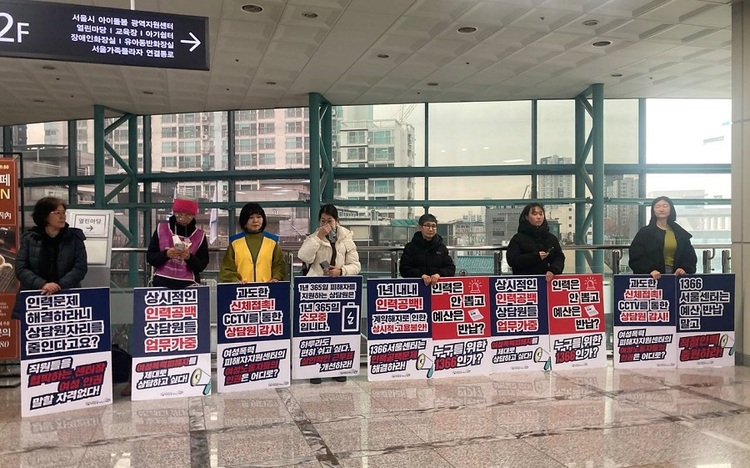
The Women's Emergency Hotline 1366 is an emergency counseling and protection service operating 24 hours a day, 365 days a year, for women in crisis due to domestic violence, sexual violence, stalking, sex trafficking, dating violence, etc. It provides initial support such as providing emergency shelter, connecting with medical and legal services, and connecting to 112 or 119. According to information provided by the Ministry of Gender Equality and Family, 1366 has a center in each of the country’s 17 administrative divisions [provinces and major cities], and additional locations have been added in Seoul and Gyeonggi, bringing the totals in those areas to two operating locations each.
In fact, such a general explanation alone is insufficient. This is because 1366 is not merely another assistance call center, but a product of the women's movement that has been in operation since the 1980s. It is also a bulwark for victims, where women facing crisis situations such as domestic violence or stalking can request help by phone 24 hours a day.
The counselors of this very 1366 are waging a struggle. They are demanding resolution of the issues of high-intensity labor, which prevents them from taking full rest, and job insecurity. They are also raising their voices to assert that guaranteeing the labor rights and human rights of counseling workers is ultimately about protecting the 1366 system that supports victims of gender violence.
On April 22, the monthly forum “We Are Fighting to Prevent Burnout Among Counseling Workers – The Struggle of the Women’s Emergency Hotline 1366 Seoul Center Branch” organized by the Center for Gender and Labor Health Rights at the Korea Institute for Labor Safety and Health was held online via Zoom. The event featured members of the Women’s Emergency Hotline 1366 Seoul Center Branch of the Seoul chapter of the Korean Public Service and Transport Workers' Union (KPTU), an affiliate of the Korean Confederation of Trade Unions (KCTU). Branch president Park Eun-young and a person identified as Office Manager A explained the reasons for their struggle and the current situation.
1366, the Fruit of the Women's Movement and the State's Responsibility Regarding Gender Violence
Branch President Park Eun-young explained the significance and history of the Women's Emergency Hotline 1366.
“The women's movement shattered the social perception that dismissed domestic violence and sexual violence as private matters, instead defining them as clear human rights violations for which the state and society must take responsibility. Amidst this trend, the Domestic Violence Prevention Act was enacted in 1997, and the system [to uphold this law] was launched in 1998 when the Ministry of Health and Welfare opened ‘Women 1366’ centers in 16 metropolitan cities and provinces nationwide.”
In its early days, 1366 faced significant limitations, such as a lack of budget, low public awareness, and reliance on volunteers. Branch President Park stated, “Women’s organizations persistently demanded that 1366 operate as a practical system capable of providing emergency relief and connecting callers with medical, legal, and protection facilities, rather than just offering simple counseling.” As a result, “in the case of the Seoul Center, nine staff members for the center were hired by the Ministry of Gender Equality and Family in 2001, and three-shift work and the operation of an emergency shelter began.” She added, “Since 2014, the Social Welfare Foundation of the Jogye Order of Korean Buddhism has been entrusted with its operation, continuing to the present.”
The 1366 hotline, inscribed with the history of the women's movement, is today “a key hub for responding to gender violence and its most alert detector.” Branch President Park Eun-young stated, “As of 2024, the total number of consultations at 19 centers nationwide had reached approximately 290,000, with the 1366 Seoul Center alone handling over 31,000 cases, more than 10% of the total.” She added, “Whenever new forms of violence occur, such as stalking, deepfakes, and digital sexual crimes, the phrase ‘Contact 1366’ appears at the bottom of government policy announcements or news articles.”
Counselors Suffering from Sleep Disorders Due to Grueling Three-shift Schedules
While 1366 protects the lives and safety of victims, the lives of the counseling workers who actually answer the calls are being seriously threatened. Office Manager A of the Women's Emergency Hotline 1366 Seoul Center Branch pointed out, "The core problem is the killer three-shift schedule consisting of 'day-afternoon-night-rest (off).'" [Editor’s note: For example, this schedule would work something like this: Monday – 7 A.M.-3 P.M.; Tuesday – 3 P.M.-10 P.M.; Wednesday – 10 P.M. to 7 A.M. on Thursday; Thursday – “off”; Friday – 7 A.M.-3 P.M; and so on, with no change on the weekends.]
According to the office manager, “Workers are required to handle as many as 7 or 8 night shifts (all-night shifts) a month. Even the days nominally called ‘days off’ are not actually full days off. This is because they are merely times to catch up on sleep after finishing a night shift and returning home in the morning. As a result, the lives of 1366 workers can be summarized by the miserable phrase, ‘going to work every day and sleeping every other day.’” (Related [Korean-language] article: “Female Counseling Worker, Is a 3-Shift ‘Off’ a Real Day Off?” https://ildaro.com/10358)
This work pattern has a serious health impact. “Counselors routinely suffer from physical ailments such as cystitis and herniated discs, as well as insomnia and sleep disorders.” Office Manager A explained that working during night shifts is particularly distressing. “During nighttime hours, calls pour in from high-risk clients disclosing suicidal impulses or extreme trauma. The counseling workers , who are experiencing cognitive decline and a dazed state due to sleep deprivation, are not able to provide the best support to these clients and so suffer from guilt and vicarious trauma.”
They also complained that the ‘right to rest’ is not guaranteed even when physical and mental health is threatened. They stated, “At the 1366 Seoul Center, paid sick leave is not properly guaranteed, so workers requiring surgery or hospitalization are forced to use unpaid sick leave after exhausting all their vacation leave.” Branch President Park Eun-young emphasized, “The majority of counseling workers are women in their 40s and 50s, and despite the very high risk of developing health problems due to the nature of shift work, they are not even guaranteed the minimum right to health.”
Counseling Workers Leaving… Anxiety Heightened by 1-year Contract Employment
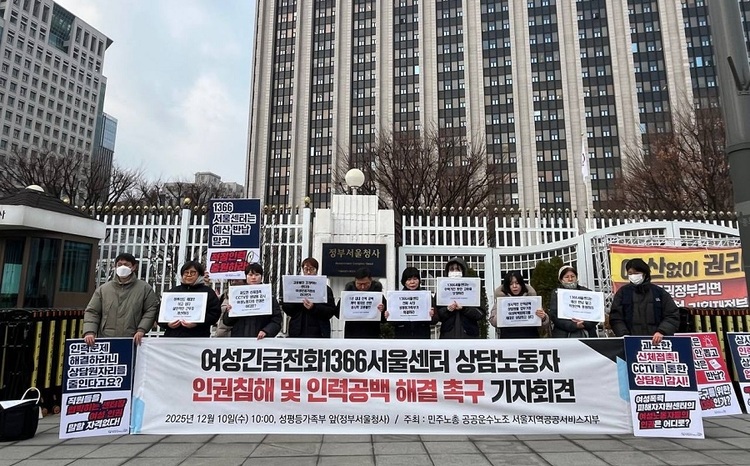
The working environment is poor, and “issues such as workplace harassment and CCTV surveillance are constantly being raised,” leading to constant staff turnover. Office Manager A explained, “At the 1366 Seoul Center, the turnover rate was high between 2020 and 2024, with the annual average number of resignations reaching half of the staffing quota, and in 2025 alone, there were more than 20 job postings for counselors.”
However, it was pointed out that the organization is increasing anxiety by hiring counselors on one-year contracts while making no effort to improve working conditions, which is the fundamental cause of the staff shortage.
Branch President Park Eun-young pointed out, “An even more serious issue is that management is abusing performance evaluations as a means to oppress and control workers.” She added, “The 1366 Seoul Center [supposedly] keeps evaluation indicators and individual evaluation results strictly confidential. [But a]s the contract renewal period approaches, management notifies employees of their low evaluation scores based on arbitrary and abstract reasons, such as ‘not getting along with other employees,’ regardless of their job skills or expertise, effectively pressuring them to resign [by making them stressed and miserable].” Workers are criticizing this as “an abuse of personnel authority and workplace harassment aimed at weeding out employees who raise issues regarding unfair working conditions.”
Branch President Park explained that such controls lead to job insecurity for workers, creating a vicious cycle where "contract counselors remain silent and cannot even confidently request sick leave when they are ill due to the fear of their contracts not being renewed."
Furthermore, Branch President Park argued that “it is a result of being neglected without any management or supervision of the agency entrusted with the actual work, although the government puts forward 1366 as a key institution for measures against gender violence,” and that “the Ministry of Gender Equality and Family and local governments must take responsibility for operating it.”
Is the State Outsourcing and Neglecting the Support System for Victims of Violence against Women?
Is it possible to fully support victims of gender violence within a structure where burnout and turnover among counselors keeps occurring? Last March, six counseling workers at the 1366 Seoul Center took direct action by forming the 1366 Seoul Center Branch under the Seoul Regional Public Service Chapter of the KCTU-affiliated Korean Public Service and Transport Workers' Union. Following 12 rounds of collective bargaining and two rounds of mediation by the Regional Labor Relations Commission, the union secured the legal right to strike last December. As of April 23 of this year, they are in their 19th round of negotiations.
What they are demanding is not special treatment. It is the minimum working conditions necessary to sustain crisis response 24 hours a day, 365 days a year. The four core demands are as follows.
- “Two-Off”: Guarantee of proper rest days through allowing for two consecutive days off at least once a month.
- Compensatory Leave: Provision of compensatory leave if a public holiday coincides with an off-duty day (sleep time following night shift).
- Job Security: Discontinuation of one-year contracts and guarantee of employment contract periods identical with the outsourcing contract period.
- Recognition of Labor Unions: Guarantee of legitimate union activities, including the guarantee of time-off (working time exemption system [in which time spent on labor union activity is treated as working hours]).
Branch President Park Eun-young asked for the public's attention, stating, "The union is not giving up the fight to conclude a collective bargaining agreement, conducting publicity campaigns inside the Seoul Women's Plaza building every Tuesday through Thursday."
The struggle of the 1366 counseling workers urgently demands accountability for the "support system for victims of violence against women that the state has outsourced and neglected." [Translated by Se-young Kim]
*Original Article: https://ildaro.com/10447 Published: May 4, 2026